Showing posts with label Incredible India. Show all posts

26 March 2013

Rock Garden, Chandigarh - It Rocks!

I recently made my third visit to the famous Rock Garden in Chandigarh. Every time I go, I find new additions to art pieces, but this time I observed that the garden has undergone a sea-change and become a popular amusement place for picnickers and families.
A small hole in this wall(behind these visitors) is the ticket window.
The Rock Garden has expanded in area, and has now three phases.  The entry ticket, is a nominal Rs 20/-. The ticket window itself is a small hole in the boundary wall which I found quite interesting and it goes well with the very small arch-doors and narrow and twisted walkways that lead inside to Phase 2.


Phase 2 has exhibits which gives a hint of how waste material can be used in a creative way. There are displays on use of electrical wastes, broken terracotta pitchers. The Phase 2’s  winding corridor takes one to a scenic waterfall, which is always crowded as everyone wants to take a picture here. On the remaining stretch, I walked through rock sculptures of human figures,` man-made’ -real-looking tree-roots and other fancy structures.

Artificial and real trees!
Phase 3 begins with a low arch entrance, just when the Phase 2 ends.
The walkways are pebbled  throughout using medium size rocks which gives the the feel of a complete rocky environment along. The rough finish on the vertical constructions like pillars and walls adds to the terrain. In some places, they have erected huge pillars and walls by simply stacking cement-bags above each other, which I assume had become unusable elsewhere by getting wet or moist. Phase 3 is the largest in terms of areas and is full of small galleries. 
One gallery has fish aquarium alongside its wall, another gallery has several fun mirrors which distort the onlookers body image causing much laughter. Everyone laughs at themselves. There is a toy train and an open auditorium which is used for various cultural programmes. Phase 3 is more of an amusement park with very little original, typical Nek Chand- style mosaic statues. It is an arena for entertainment and picnicking.


The Phase I is the oldest  site, the original part from where this garden took off and is now the last part on the visit. It still has the same charisma and awesomeness and you are spellbound by the site of hundreds and hundreds of figurines covered with colourful broken crockery, tiles and bangles.


I will like to share the depiction of the place verbatim, as expressed by the authorities at the site -
`Chand & Chandigarh - The making of Chandigarh provided the site, opportunity and material for Nek Chand's own creation and the city's people and Government have supported his work. Without Chandigarh there would be no rock garden. Yet there is a clear contrast between, the city's grid pattern streets linking sector to sector and the Rock Garden's labyrinthine paths on which the journey is the purpose.’ - Nek Chand Foundation.


The small room  where this creative journey took off!
Rock Garden for the World - In over 50 years of endeavour, Nek Chand has used his technical know-how to turn his vision into a reality. From its heart at the hut that was once a secret, it is now a total environment that is open to all. Some see the Rock Garden as a recreation of the childhood village of Nek Chand's memories lost to him through the trauma of partition in 1947. Others see a universal home that unites the creatures and elements of nature, and soothes the spirit of the peoples of the globe.'--expressed outside a small mud hut where he first started making these wonderful pieces secretly during his free time.

Please follow me here to take a journey to the garden--


14 March 2013

Nalanda Mahavihar - A Treasure unearthed!

As I travel more and more, my country India, keeps surprising me. I realise that one life-time is too short to see all the wonders this land has inherited. I had always heard of the ancient city Nalanda, and when I visited I was absolutely amazed by its modernity in planning and vision thousands years back.

History of Nalanda goes back to the days of Mahavira and Buddha in 6thC B.C. It was the birth place of Sariputra, one of the famous disciples of Buddha. In 5thC AD, the place became popular as a major monastic-cum-education centre in learning oriental art and education in the Buddhism world and attracted students from all over the world. The galaxy of scholars associated with Nalanda includes Nagarjuna, Aryadeva, Vishubandhu, Dhrmapal and Suvishnu. The celebrated Chinese travellers like Hiuen Tsiang and I-Tsing  have extensively described the monasteries and the lives of monks here. As evident from the inscriptions, various subjects like Theology, Medicine, Astronomy, Metaphysics and Philosophy were taught here and the Gurukal was funded by the revenues collected from the villages for education.

Nalanda Mahavihar is considered as the greatest university of the ancient world. It was founded and supported by King Kumargupta I of the Great Gupta Dynasty in 4th-5th C AD, King Harshvardhana of Kannauj (7thC AD) and continued getting support from the subsequent kings. The decline started from Pala Dynasty and its final fall came from invasion by Bakhtiar Khilji in 12thC AD.The excavations done by ASI starting from 1915, revealed the vastness of the university, and it showed a clear presence of a very organised and systematic layout of six brick-shrines and eleven monasteries.

Nalanda was one of the world’s first residential universities with dormitories for students. It was also one of the most famous universities. In its heyday, it accommodated over 10,000 students and 2,000 teachers. The university was considered an architectural masterpiece, and was marked by a lofty wall and one gate. Its library was the most renowned repository of Hindu and Buddhist knowledge in the world at the time. Its collection was said to comprise hundreds of thousands of volumes, so extensive that it burned for approximately more than three months when set aflame by Turkish invaders!

A 30 meters passage passes from north to south through the entire campus with temples and monasteries on either side.

The most extensive is temple no. 3, which was constructed in seven phases and is surrounded by a number of votive stupas and a group of many small shrines. The first four phases revealed during the excavations were small, dilapidated and, therefore, covered back. The 5th, 6th and 7th phases are clearly marked by the presence of staircase at different levels. A large number of small votive stupas and shrines, perhaps, were added by the devotees at different times. Among these is a distinct chariot shaped shrine, which is visible to this day.

Similarly, monastery no. 1 is very significant from chronological revealing of nine levels of occupations indicated in superimposed structures like drains and rooms.

The basic structures in all the monasteries are same. All of them have classrooms, Monks residences and student hostels with washrooms and a library. The courtyard has a kitchen and granaries to store grains.

In addition to the structures, many sculptures and images in stone and metal have been unearthed. Prominent among these are the various postures of Buddha and the sculptures of Hindu deities and Mythological figures. I was told that the other significant excavations like murals, copper plates, coins, brick inscriptions and terracotta pottery etc. have been shifted to a nearby museum.

Unfortunately,I could not see these collections at the museum, as the museum was closed on that day. But the information unfolded before me, when I stood there amongst ruins, took me back into the history thousands of years back and I could see  monks roaming everywhere, engaged in different activities. I could see Guru-shishyas in the classrooms, people meditating in small rooms and under the trees and others engaged in stone-sculpturing surrounded by beautifully carved statues. No wonder, India is known as the birth-place of all civilizations.

Sources: Wikipedia; Printed material and Guide at the site on my personal Visit.

15 May 2012

National Fossils Park, Ghughua, M.P.


National Fossils Park, Ghaghua, is a unique park as heaps of plants fossils have been found here. These fossils tell us the types of plants that existed here some 65 million years ago. These fossils are older than the human race which itself is considered to be .2million years old. Their age makes this place priceless. Considering the scientific importance of these fossils, the government of Madhya Pradesh has given the status of a national park to this place in 1983.
Well preserved fossils of trees, creepers, leaves, fruits, flowers and seeds have been found here. The plants belonging to the eucalyptus family are most commonly and prominently present here.
Interestingly, some of the types of these plants also exist today in different parts of the globe.
It is thought that 65 million years ago, this part of the land had evergreen forests like the ones that now exist in the western ghats and north-eastern India. These forests had plants of all sizes with some very tall trees. Ghaghua would have had a long rainy season with warm and humid atmosphere. Due to the presence of the fossils of some shelled animals like snails and molluscs, it is thought that there was a large water body there, which according to the scientists could possibly have been  a branch of the Arab Sea --- now called the Tethis Sea.
Spread over an area of app. 27hectares, the park is situated on NH no. 11, 76Km from Jabalpur.
I share some fossils' pictures here which will give an idea of how amazing the place is--


09 May 2012

Jabalpur City - A `badaa Gaun', as the localites call it......

Jabalpur, an important administrative town and commercial centre, has not grown physically as it should have. Once a pleasure resort and the capital of various ruling dynasties like the Gonds, the Kalachuri and the Marathas, and then established as a spacious cantt with colonial residences by the British, the city today, gives an impression of a rural area with ill-maintained roads and barely-there traffic discipline. The roads are in such a deteriorated condition as if these were never built. Because of this rawness in the look of the city, the local people like to (or find it hard not to) call it a badaa gaun or a big village !
I found the people of Jabalpur simple and warm to the visitors. Jabalpur itself has few attractions for the tourists but it definitely gives an opportunity to see some wonderful places around it--
Bedaghat  -
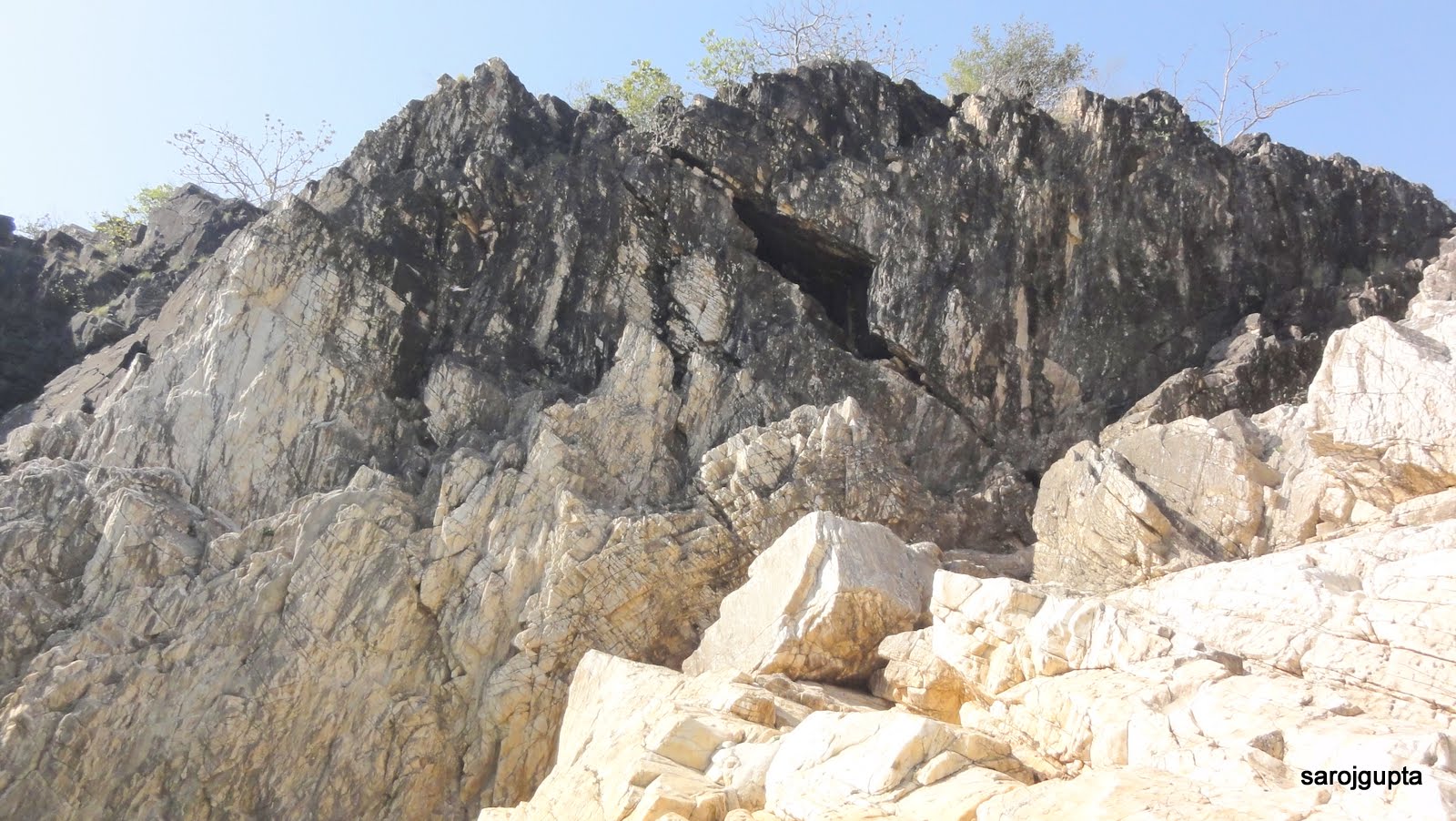
The famous marble rocks of Bedaghat rise upto 100ft on either sides of the river Narmada and glitter like silver when showered by sunlight or moonlight. A boat-ride (available from Nov. to May) on the serene waters of Narmada gradually unravels the beauty of the multi-hued rocks and takes one through the narrowest point, Bunder Kudani or the `monkey's leap' where the rocks on the two sides are the closest and only a few feet away. 
`Brahma Vishnu Mahesh'
Beautiful peaks
Nandi Rock
The narrowest point between the rocks on two sides- `Bunder Kudani or Monkey Leap'

The guide in the boat will keep you further entertained by pointing out rocks where various films have been shot, or by telling you some of the locally-ascribed rock names based on perceived shapes like, Brahma-Vishnu-Mahesh, Nandi Bull, a saint being pushed by a disciple or a crocodile's den etc.; or by his funny, poetic style of narration.
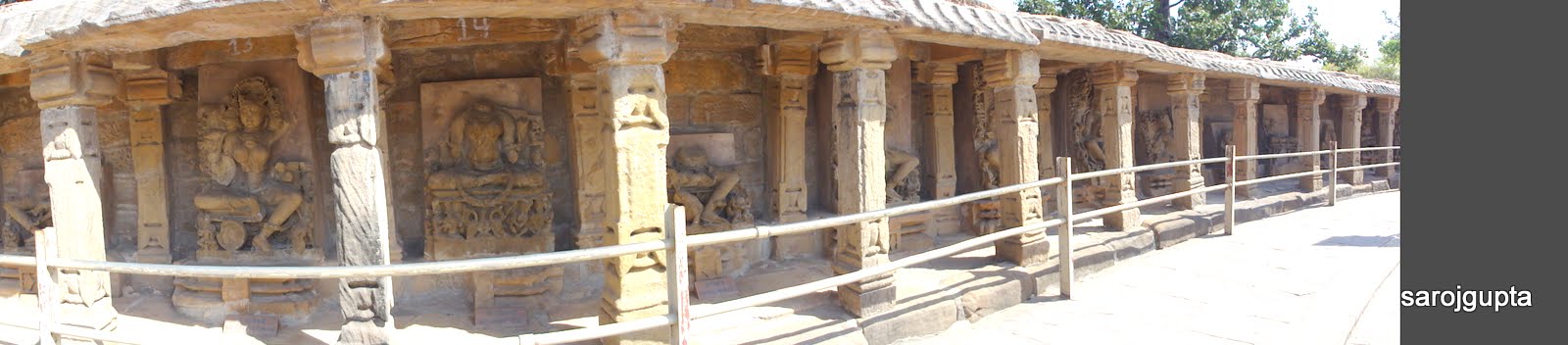
As you climb back to the street, some 100 yards away is a wonderful place known as the Chaunsath Yogini Temple. Situated atop a hillock, this temple can be reached by climbing a flight of 108 steps (I did not count but the little kid who followed me to the temple was more than 100% sure and his confidence and knowledge about the place made me consider him my guide ). I wanted to know more about him than the place. He is a school-going kid and during his free time he does this part-time amateur guide service. He told me that he wanted to be a `big guide in a bigger city' when he grew up.......so sweet!
The 11thC Shiva temple

Chaunsath Yoginis corridor


Some of the 64-yogini statues are quite intact

The 10thC Shiva temple has sixty-four exquisitely carved statues of different forms of the goddess Durga installed in a circular corridor surrounding the main temple. Though mostly damaged with time, some of the statues are in a relatively good condition.
The temple gives a beautiful view of the Narmada passing amidst jagged marble rocks.
The legend says that the temple is connected to the Gond queen Durgavati's palace through an underground passage. 
The Narmada making its way through the marble rocks, narrows down and plunges into a waterfall. Surprisingly, the height of the fall is not much, but the force with which it falls makes such a loud sound that its roar can be heard from quite a distance.The splash of the water gives it an all white, misty look, hence they are called the dhuandhar waterfalls or  the smokey cascade! The water at the fall looks extremely foamy and the stone present there is called soapstone due to its softness.

Dhuandhar Falls behind us

One must stop a while to admire the artistic hands working on the stone there and turning it into beautiful artefacts.
Bargi Dam On Narmada---
Serene Narmada in Bargi


To view the Narmada at its best, one must visit Bargi, 40km from Jabalpur, where a dam has been built over the expansive river. The boat cruise `Narmada Queen' by MPSTDC is available in the evenings. It also makes a scenic picnic spot.

Jabalpur Local--

Shree Mahadev Temple--

The people of Jabalpur are very proud of this recent possession of a Shiva temple, which is distinct in having a huge statue of lord Shiva and not the usual Linga; the statue is placed on a high podium in an open courtyard and not under a roof in a shrine. There is an equally big Nandi bull in front of the murti. This distinction is currently getting more tourists than the devotees to the place.
Balancing Rock--
Balancing Rock


In a rocky terrain, there are massive boulders lying precariously on  other rocks and have been balancing like this for centuries. One  such rock just sits  with a very narrow contact with the base rock and gives an eerie may-tumble-down-anytime-soon feeling  and mocks  man's vulnerability to natural calamities.
Rani Durgavati Memorial--
Queen Durgavati Memorial


This memorial is dedicated to the great queen Durgavati considered even more valorous than the Rani of Jhansi and the museum closeby exhibits a fine collection of sculptures and pre-historic relics.
Peesanhari Jain Madhiya(Temple)-- The following couplet best describes this 650 years old Nandishwar temple-
पीसनहारी  पीस-पीस कर बना गयी एक मढ़िया
इस मढ़िया में नन्दीश्वर की रचना इतनी बढ़िया . 
The legend says that an aged mother, who lived here, used to grind flour by a hand grinder (haath ki Chakki ) to earn her livelihood and got this temple made from her savings. The design at the top represent the slabs of a chakki and is a symbol of respect to labour and hard work.  
It has a massive Nandeeshwar's Jainalaya in its premises with a large number of mini Jainalayas in the main hall.
Shree Nandeeshwar Jainalaya looks like an open air temple because of the starry-blue ceiling!

Small Jainalayas in the central hall

Peesanhari Temple on the hill-top


It has an unusual design for a temple. The main temple is upon a hillock and can be accessed by  stairs. 
I did not know that a small city like Jabalpur, which I had merely considered  a stop-over   in my journey,  had so much to offer to a tourist.
Some more photos here-

27 February 2012

THIRUVANANTHAPURAM

The capital city of Kerala, Thiruvananthapuram---- formerly Trivandrum, got this name recently. The word Thiru-Ananth-puram means the sacred city of lord Ananta. The city gets the name after the mythological Sheshanaag Ananta on which the deity Vishnu or Padmanabhan reclines in the famous Padmanabhaswamy Temple.
Padmanabhaswamy Temple--

Shree Padmanabhaswamy Temple


100-feet high, seven-tierd Gopuram with its intrcate carvings depicting mythological stories


Shree Padmanabhaswamy Temple dates back to 6th-9thC and is built in Dravidian Style of Architecture. The main gopuram (Shown in the pic above) was added later in the 16thC. Inside the main shrine (photography not allowed), the deity of Vishnu resides in a reclining posture on the five-hooded Ananta Shesh. The Lord's right hand is placed over a Sivalingam and Vishnu's two consorts, Sridevi and Bhudevi are present by His side. From Lord's naval appears Brahma on a lotus. The main idol is said to have derived from 12000 small shivalingas brought from Pashupatinath temple in Nepal. The deity can be seen through three doors in parts.
Shree Padmanabhaswamy Temple is considered to be one of the richest temples of India due to its rich monumental and ornamental inheritance and is run and controlled by the temple  treasury.
The most impressive part of the temple is a long corridor on all sides with 365 and a-quarter stone pillars with carvings and is an ultimate example of  the Vishvakarma Sthapatis. Standing at one end of the corridor, it leaves the visitor speechless due to its amazing beauty.
There are many other small temples in the compound.
Govt. Museum Complex--
Napier Museum, Natural History museum, Shree Chitra Art gallery and a zoo are present in the complex.


Beautifully maintained gardens of the complex.


Napier Museum


Napier Museum or The Govt. Arts and Crafts museum is a beautiful red and black brick structure which houses a rare collection of artifects of bronze, stone, gold and ivory and a huge wooden chariot.
Sree Chitra Art Gallery holds some famous paintings by Raja Ravi Varma, the internationally renowned painter from this state.
Pazhavanagady Ganapati Temple--


This Ganpati temple is very popular among the localites and is an ancient beatiful temple in black stone.
Attakul Bhagvaty Temple--
Attakul Bhagvathy Temple

  
This temple is reverred as the `sabrimala' for women, hence visited mostly by womenfolk. The legend has it that the goddess Attakul Bhagavathy is a form of Kannaki, an incarnation of Goddess Parvati. Attakul Pongal is the main festival celebrated at this temple.
The temple holds the Guiness Book of World records for recording the highest number of women in one place at one time anywhere in the world. (app. 3million women thronged the temple to celebrate `pongal' in 2010). 
Padmanabhpuram Palace--
Padmanabhapuram Palace

It is a magnificent wooden palace of 16thC, located in Thackalay, some 64km from Trivandrum. It is an old palace of the rajas of Travancore and is an excellent example of Kerala's indigenous style of wood housing.


All the structures in the campus are made of wood with a triangular projection atop every gate and sloping roofs. The floors, which are very smooth and shine like granite are actually made of jaggery, cocconut oil and charcoal and lime.The interior is made of beatifully carved rose wood.
Poomukham-


Poomukham

In the main palace, the first structure is a Poomukham, to wlcome guests and has some rare displays like a hanging brass lamp with a knight on a horse, a chinese chair and a bed made  by joining seven pieces of shining granite stone etc. The wooden ceiling has 90-carved flowers which are all of different patterns!

Manthrasala

The Manthrashala, one floor above Poomukham, is a prominent hall with a single projection for seating with 11-windows which have beautifully carved shutters with mirrors.  It has beautiful carved, chinese chairs where ministers sat with the king for discussions over important matters. 
Ottupura or the dining Hall Entrance

Oottupura or the dining hall made on two floors could feed 1000 people on each floor on a daily basis! The kings were known for their generosity and hospitality.
Thai Kottaram-

Thai Kottaram


Thai Kottaram

Thai Kottarram-The oldest palace in the complex was built in the end of the 16thC, in a traditional Kerala Nalketu style. Its outer veranda has a pillar carved out of jack-fruit tree and made of a single piece to support the ceiling, and has exquisite carving on it. The special flooring has withstood the test of time. The hall was made to carry out various ceremonies to appease the Goddess. A tunnel route for emergencies starts from its courtyard and connects it to another palace 1-km away from it.
The armoury was housed in a building with long rooms without any windows for any light or ventilation to store a huge collection of arms. There is a watch tower for vigilation.
The King's Bedroom-
The King's bedroom with a highly immunising bed !
Grand carvings on the ceiling


A moderately sized room is distinguished by the presence of a bed made by using ninety  pieces of medicinal herbs. There is a chinese chair with  very fine carving. The ceiling is beautified by intrinsic carvings on the wooden beams.
The hall with a mirror, a swing and some paintings

There is a Belgian mirror that is 300-years old and has a silver coating on its back for reflection kept in one of the rooms in the palace. This room also houses several very old Thanjavur paintings. These paintings are conspequence by the absence of the gold foil in them which is considered now as the distinguished part of the Thanjavur paintings.  

Ambari Mukhappu

Ambari Mukhappu

Ambari Mukhappu is the building made for the kings to view chariot races and give public appearances. The structure is built in the shape of an Ambari- the seat put on the elephant, and is a fine example of craftsmanship of Kerala wood carving.
Navaratri Mandappam -
Navarathri Mandappam with its `Mirror Floor'

Wooden partition with viewing holes


This building was built in 1744AD and is the only solid rock structure in an otherwise wooden palace. It is a 66-feet long and 27-feet wide structure famous for its unparalleled architecture of intrcately carved rows of pillars. Its unique floors are polished to mirror-like perfection and due to clear reflection it is called as `kannadithara' or `mirror floor'. Various cultural programmes were conducted here during navaratri festival. Small, viewing windows are made in its wooden panels in walls for the royals to view the performances from behind the wooden screens.
The Temple in Navarathri Mandappam


A part of the long corridor has the palace temple at its far end. There is, also a large collection of ancient stone statues on display in this part of the palace which have been collected from the different parts of India.
The Museum


There is a museum in the south part of the palace which is rich in having on display some very ancient stone, wood and metal architecture in the form of statues, furniture, lamps and murals.


Most interesting part in this museum is a collection of engraved stone pillars which are scripted and served as documents then.


Some pictures of the beautiful and serene back-waters of Kerala --

Away from the madding city life--->

God's own country !

A panoramic view

I just loved the reflections in the water- .Reflections..........of house-boats...........

--->Reflections of trees...

Waiting to enjoy the sun-set view--->

Beyond that beach is The Arabian Sea. The continuity of water into back-waters (where there is no beach) on the left is an estuary.....